

By Danny Cohen
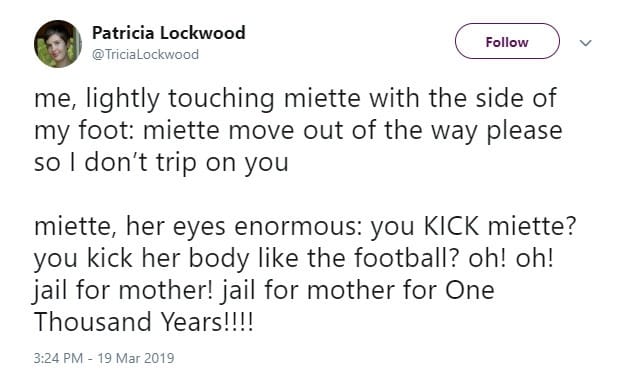
Every detail is perfect.
First, unless you are in the small minority who were already following Lockwood when you saw this tweet, you are left to infer that Miette is a cat. This inference is easy because it speaks to something familiar. Cats do be like that. But it captures this obvious truth with a level of strangeness and specificity that makes it feel new and allows it to lodge in the mind. Almost no opportunity for that strangeness is left unexploited.
Miette saying “the” football instead of “a” football, like a French aristocrat in a cartoon. Her cry of “oh!” occurring twice in a row. Ending on not one or three but four exclamation marks. The surgical use of capital letters. I can’t explain exactly how “One Thousand Years” differs from “one thousand years,” but I know it is different.
No one of these choices can be fully explained beyond saying it feels right, and it's funnier that way. The whole thing operates on an intuitive presentational logic that feels both fully formed and a little alien. Like many of the greatest tweets out there, I see here not just a funny joke but the work of an artist operating with a deep understanding of their craft.
This tweet makes an especially convenient example because its author, Patricia Lockwood, is an accomplished writer in more traditional forms of literature as well, including essays, poems, novels, and a memoir. Her stunning novel No One is Talking About This digs into the emotional and cognitive nuances of the Twitter experience like almost nothing else I've seen (while never mentioning the platform by name). Its protagonist “[became] famous for a post that said simply, Can a dog be twins?” and near the novel’s beginning speaks at a conference where she “[tries] to explain why it [is] objectively funnier to spell it sneazing.”
But the silliness and inanity on display operates symbiotically with a deeply poetic sensibility, a picture of the extremely online headspace as an endless dreamlike tumble of glimmering possibility. When she’s searching her notebook for her latest post idea, the narration reads, “What had the beautiful thought been, the bright profundity that she had roused herself to write down?” When her husband asks what she’s doing on her phone: “Couldn’t he see her arms all full of the sapphires of the instant?” Both of these moments are immediately undercut by something crass or stupid. It’s great stuff.
Urgent offline reality ultimately intrudes on this half-pleasant, half-anxious haze, changing the protagonist’s perspective on the world in her phone. No One is Talking About This could be described as an exhortation to detach from screens, talk to people for real, live an actual life. But this would be reductive, erasing how compellingly Lockwood portrays the intoxication of “the portal,” as she calls it. It can be hollow and even dangerous, but it can also be a place of wild absurdity and surprise and invention. Of course it would exert a pull. Fertile creative realms always do.
The tweet (or skeet or short-form post) is a literary form, one that is most often comedic but is not limited to comedy. Not all tweets are literature, but neither are all books. In the world of books we have labels such as “creative nonfiction” to help us navigate the grey areas, but we don’t really need them to know that the nonfiction book is an artform regardless of how many non-artistic examples exist.
Short-form posts with literary value can appear on other platforms, such as Bluesky or Tumblr or even Letterboxd, but Twitter was where the most important evolutionary steps took place, and given that the Twitter of our memories is effectively dead I’m just going to call them all tweets because no other option is any less fraught or stupid.
Like every artform, the tweet does things no other form can do, and comes with its own set of expectations and animating questions. It deserves more serious consideration than it is often afforded, and even its most expert practitioners often seem disinclined to advocate for it on that front; aside from the fact that some of them are anonymous or always in character, it is just wildly uncool to insist upon your own importance. Almost as uncool as spending three paragraphs explaining why a cat tweet is funny.
While I’m being uncool, I’ll go ahead and brag about my own brush with virality. It was in my last few months on Twitter (I refuse to call it X), before the 2024 election rendered the growing Musk stink fully unbearable. My friend Sara had just undergone dental surgery and our group text was riffing. I found a picture of a tooth, slapped a silly caption on it, sent it to the group, then decided it was funny enough to tweet. Another friend with a sizable following retweeted, and it amassed over 100,000 likes over the weekend. Here it is:
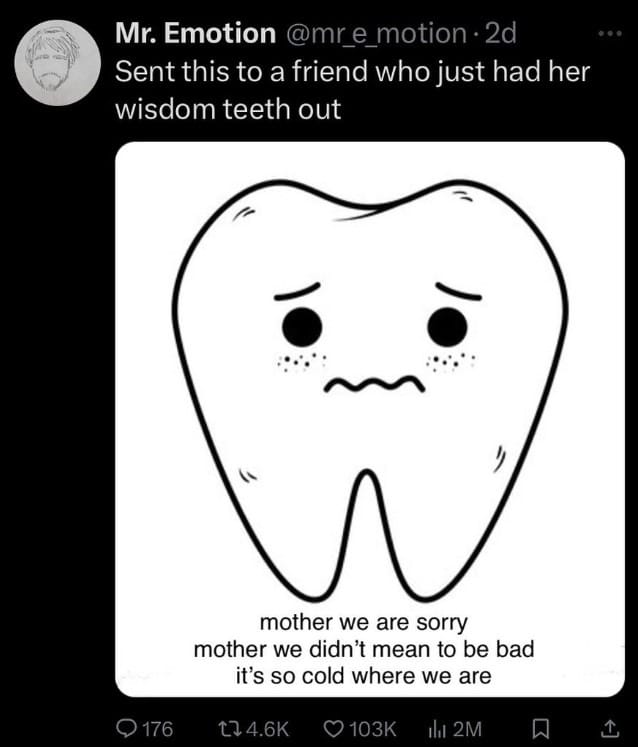
The tweet reads:
Sent this to a friend who just had her wisdom teeth out
Beneath the text of the tweet there is a picture of a cartoon tooth looking sad and worried. Within the picture is text beneath the tooth, reading:
mother we are sorry
mother we didn’t mean to be bad
it’s so cold where we are
It was a surreal experience. There were hundreds of comments, some appreciative and some bizarre. Several people thought it was about abortion. One sincerely angry person said it was “an infohazard for autistic people.” Twelve accounts followed me. The likes were almost certainly inflated by bots, but it did attain a high level of saturation. One of Sara’s other friends encountered it in the wild and sent it to her without knowing she was the person who inspired it.
My tooth post isn’t the cleanest example of the literary form I’m discussing here. There’s a whole other essay to be written about posts that involve interplay between image and text. Some other old tweets of mine better exemplify the qualities I'm writing about here, and I think they are good, but none of them have done numbers, and attempting to give them second life through this essay would feel too embarrassing even for me. Anyway, there’s a reason the tooth did well on that specific platform. It’s got the Twitter sensibility. I’m going to call it Posting Humor.
The Miette tweet has a significant dose of that sensibility in its presentation, but it’s still funny to ordinary people who think cats are cute. Almost anyone would laugh at it. The tooth post is closer to “sneazing” or “can a dog be twins.” It’s not funny in a universal way, or even universally legible as a comedy.
One of the greatest practitioners of Posting Humor is dril. A few classics:
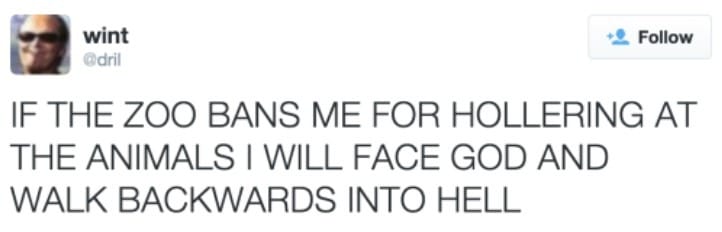
The tweet reads:
IF THE ZOO BANS ME FOR HOLLERING AT THE ANIMALS I WILL FACE GOD AND WALK BACKWARDS INTO HELL
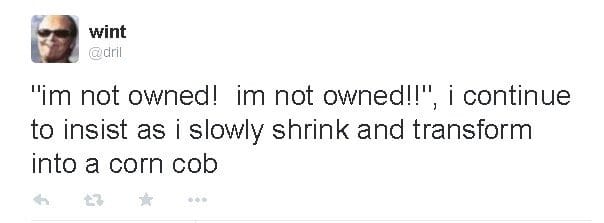
The tweet reads:
“im not owned! im not owned!!”, i continue to insist as i slowly shrink and transform into a corn cob
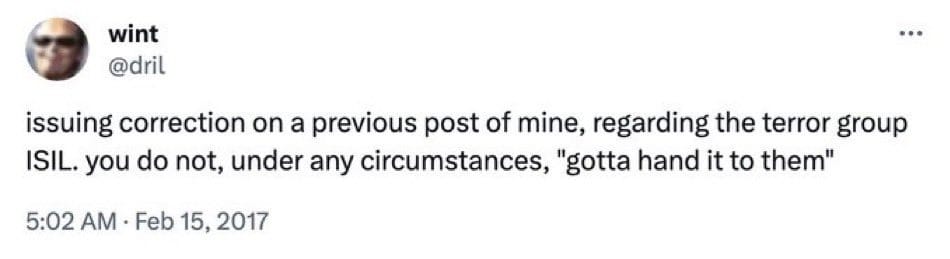
The tweet reads:
issuing correction on a previous post of mine, regarding the terror group ISIL. you do not, under any circumstances, “gotta hand it to them”
These tweets transcend mere popularity. Each has taken on a memetic life of its own, coining phrases that are used regularly online to describe or satirize common sentiments or occurrences.
What is Posting Humor, exactly? Like with any genre or category, not all examples will contain all characteristic ingredients. Some rock bands have no guitar. But there are still characteristic ingredients that can be identified.
There’s a specific flavor of weirdness, related to but distinct from the random absurdity of early aughts comedy staples like Homestar Runner. A misanthropic, cynical worldview–one that often twists the aforementioned absurdity into something closer to the bleak philosophical absurdism of Beckett or Pinter. The sense that you’re getting a tightly limited glimpse into a kind of person or even world that is alien enough to set the machinery of the imagination spinning.
The sketch show I Think You Should Leave is the closest thing I’ve seen to a translation of Posting Humor into another medium. It’s hugely popular among posters for this reason, and several of its sketches have memetic usefulness similar to that of the dril tweets included above.
But there are other ingredients of Posting Humor that don’t translate. Misspellings. Idiosyncratic use of punctuation and capital letters. Many great tweets (Miette included) are presented like dialogue in a script, but with elements (often akin to stage direction) that don’t work as well or at all when presented to the ear. Sometimes there is only one speaking character in the scene.
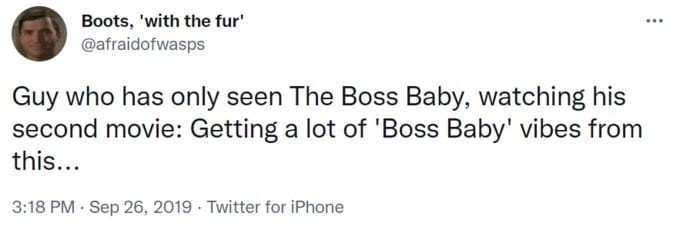
The tweet, from @afraidofwasps, reads:
Guy who has only seen The Boss Baby, watching his second movie: Getting a lot of ‘Boss Baby’ vibes from this…
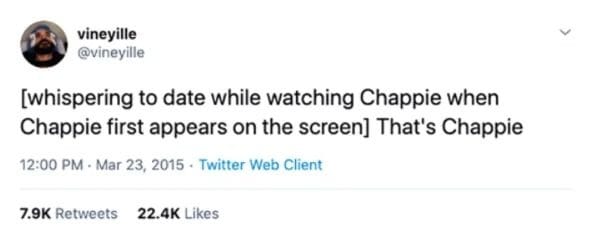
The tweet, from @vineyille, reads:
[whispering to date while watching Chappie when Chappie first appears on the screen] That’s Chappie
We understand these things best with our eyes. They’re just funnier that way.
As I write these sentences, there are several posts doing numbers among the cool kids on Bluesky (the closest thing we currently have to Twitter at its peak) about how stand-up comedians aren’t important philosophers but just silly little people telling silly little jokes. This is a reaction to a tendency among fans and practitioners of regressive comedy to dress up their bigotry in grandiose posturing. While I too have scoffed at some people’s claims about the sacred role of the comedian in society, pushing back against something stupid doesn’t automatically make what you’re saying intelligent.
Comedy has made me cry, made me feel less alone, and influenced my thinking about what it is to be a person. It is art, and like all art, it can be good or bad, light or heavy, important or disposable, silly or cerebral. It can fall anywhere on each of those spectrums and infinite others.
Anthony Jeselnik is a stand-up comedian whose work I find artistically interesting. For a stretch of his career, all of his work fell into the general mode of saying offensive things because they were offensive. He seems to have dropped that character recently, which may be for the best, given, well, everything. Still, I believe he was the only comic with any real following who was actually good at threading the “humorously offensive” needle.
Jeselnik's best offensive jokes would only scan as jokes to someone who understood what was wrong with the character he presented. Countless elements of his stage persona, delivery, and joke construction supported the audience's understanding that these statements are meant to be viewed and laughed at from a kinder and more empathetic perspective than that of the character speaking. It's an impressive trick.
Does this make him Aristotle? No. But it is interesting, and it can clarify one's own thinking in useful ways.
Jeselnik has a rough posting analog in an account called ratlimit, who specializes in bait. Bait, in the parlance of posting, is basically what it sounds like: inflammatory bullshit meant to rile up arguments. Often, an effective bait post will sound progressive on the surface but come to conclusions that reveal a kind of diseased thinking characteristic of the terminally online. Discourse run wild can break your brain and make you wonder if you understand ethics or the world.
Ratlimit plays with that, elevating bait to an art form like Jeselnik’s offensive jokes do with arrogance and cruelty, and she has a large following of generally reasonable people who are in on the bit. Often, the only thing that saves you from taking a ratlimit post seriously is the username. There's something reassuring about her posts; they stand as proof that other people can survive prolonged exposure to the inhuman logic of online without losing their sense of up and down.
Many of her best posts require so much context in posting culture or niche queer discourse that they would be inscrutable to anyone outside the ecosystem that birthed them. This example is selected in part for its relative accessibility:
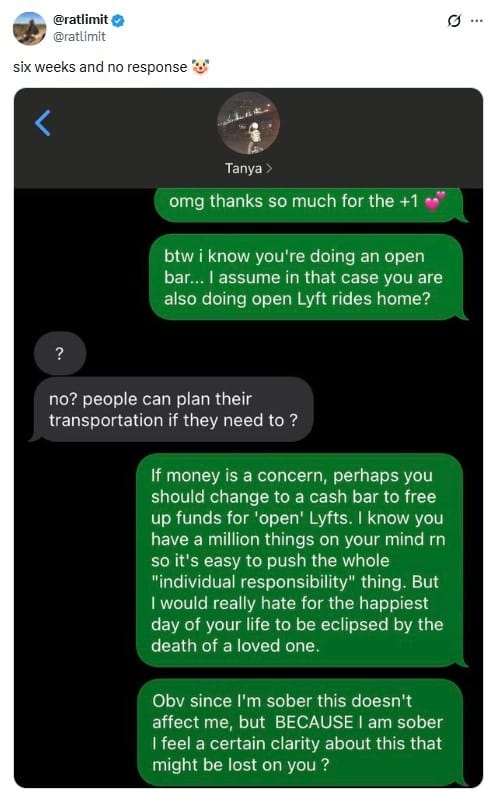
The tweet reads:
six weeks and no response [clown emoji]
Beneath the text of the tweet there is what appears to be a screenshot of a text message thread with someone named Tanya.
ratlimit: omg thanks so much for the +1 [two hearts emoji]
ratlimit: btw i know you’re doing an open bar… I assume in that case you are also doing open Lyft rides home?
Tanya: ?
Tanya: no? people can plan their transportation if they need to?
ratlimit: If money is a concern, perhaps you should change to a cash bar to free up funds for ‘open’ Lyfts. I know you have a million things on your mind rn so it’s easy to push the whole “individual responsibility” thing. But I would really hate for the happiest day of your life to be eclipsed by the death of a loved one.
ratlimit: Obv since I’m sober this doesn’t affect me, but BECAUSE I am sober I feel a certain clarity about this that might be lost on you ?
It’s easy to see something like this and get caught up in it. Do people think like this? Should I think like this? To then understand it as expertly crafted bait offers an emotional arc of tension and relief akin to jump scares, rollercoasters, peek-a-boo. To then examine it (or one’s reaction to it) through that understanding offers data about how we relate to the portions of humanity we struggle to think of as kin.
So joke tweets can be complex and interesting in form and content. So what? But as I said earlier, the literary tweet is not limited to comedy. There are certain accounts on short-form posting platforms that regularly either blur the line between joke and poetry or aim at literary goals unrelated to humor.
One such account on Bluesky is that of Angela W., also known as carpetbenzo, A. Birdfriend, and various temporary display names. Here are three consecutive tweets from the recent past:
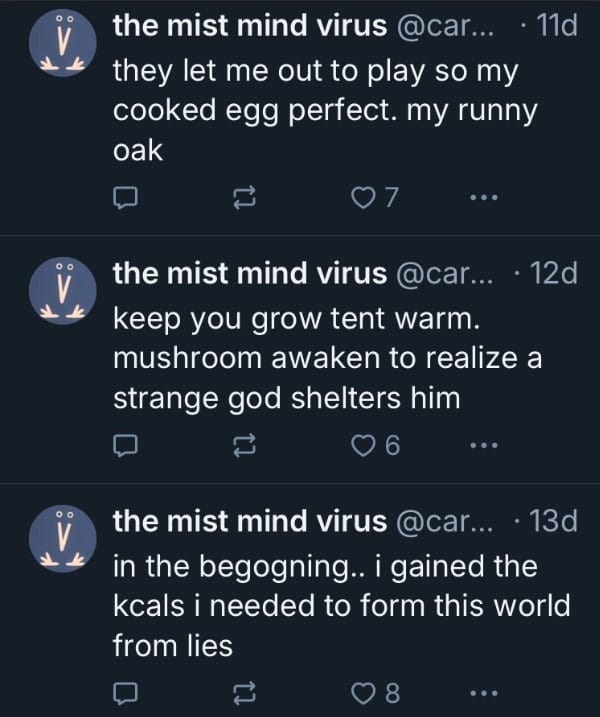
The first tweet reads:
they let me out to play so my cooked egg perfect. my runny oak
The second tweet reads:
keep you grow tent warm. mushroom awaken to realize a strange god shelters him
The third tweet reads:
in the begogning.. i gained the kcals needed to form this world from lies
The sensibility is like Posting Humor pushed so far in a specific direction that it takes on a poetic, even mystical aesthetic. It can be funny if it hits you just right in the moment, but it can also be beautiful and fascinating in ways that hold up whether you’re laughing or not. Angela W. also has a website filled with images that feel like an extension of the same artistic project. The “about” section describes them as “Advanced Memes.”
Another practitioner of the literary tweet is ctrlcreep. Like Angela W., they have a larger artistic project that extends beyond social media. They have a newsletter and two books full of their writing, which often has no element of humor. But still a great deal of their work is in tweet form.
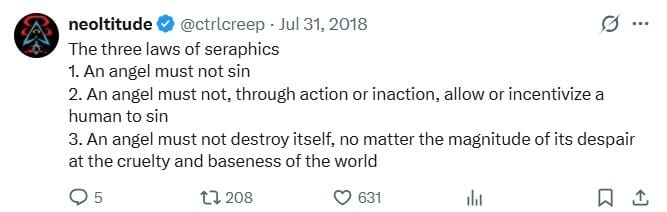
The tweet reads:
The three laws of seraphics
1. An angel must not sin
2. An angel must not, through action or inaction, allow or incentivize a human to sin
3. An angel must not destroy itself, no matter the magnitude of its despair at the cruelty and baseness of the world
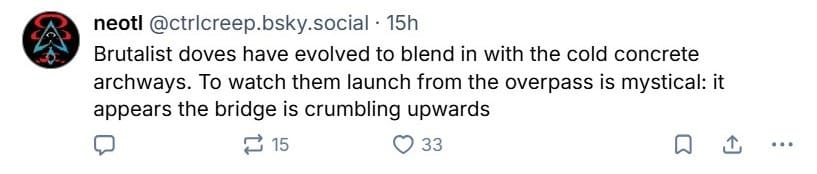
The tweet reads:
Brutalist doves have evolved to blend in with the cold concrete archways. To watch them launch from the overpass is mystical: it appears the bridge is crumbling upwards
These aren’t funny. They are beautiful, mysterious, speaking directly to the part of us that yearns to live in a world more magical, less idiotic and horribly banal than ours. A world where the next new thing we learn might actually induce wonder.
So are tweets poetry? It’s hard not to ask when it comes to some of these writers. Certainly poetry can be funny, and has straddled the gap between sublime beauty and earthy comedy in the same space at least as far back as Catullus. And the strange formatting of many tweets, the play with the raw stuff of letters and punctuation, can call to mind E.E. Cummings and similarly experimental poets.
Some poetry even feels like there could be influence flowing in from Twitter. Here is an excerpt from a Dan Magers poem published online in Hyperallergic:
As a talented writer on mushrooms,
I feel like I can convey the beauty of the multiplicity of the world.
I feel like I have reached that ability.
My girlfriend complained about my sweaty body
until I lost my erection.
Then we broke up.
Magers’ excellent 2012 book Partyknife weaves in and out of a voice drenched in Posting Humor. One poem is titled, “MIND QUEEF, A ONE-ACT PLAY BY HITLER.” That could easily be a dril tweet on its own.
But art forms can be in conversation with one another without the less established one being subsumed. And I think it's meaningful that everyone seems to agree that the proper way to share a tweet is in a screenshot. I've provided captions and descriptions here for the sake of accessibility, but screenshots are simply how the thing is done online. This is partially for material reasons; it’s easy, and it helps avoid stealing credit or eating up portions of one's own character limit with attributions. But it is also because we all just instinctively understand that tweets work best presented with traces of their original context.
Dril would seem to agree. In 2018 he published a compilation whose page presentation closely echoed the Twitter feed, even pulling the initial ebook edition to replace it with a PDF to more tightly control how it displayed.
Four years later he offered another take on the endeavor, publishing a set of four books containing his first 10,000 tweets in chronological order. People who look inside these books quickly discover that there was no attempt to make them work on the page. All of the tweets are presented in a tiny, typewriter-esque font, in chronological order, as one unbroken block of prose, divided from each other only by silcrows (this character: §). It’s exceedingly difficult to derive any enjoyment from reading them in this form. The books are less an attempt to preserve or reproduce the art of the writing and more their own conceptual comedy art objects, an implicit statement that a book of tweets is a fool's errand, that these things really live on screens.
If tweets are poetry, I would say they comprise a subset of it as distinct from ordinary verse as spoken word poetry meant primarily for the ear. And even spoken word poets generally choose the word “poetry” to frame their work, putting it in intentional conversation with other poetic traditions. Posters generally don't. They mostly just post.
Other platforms have their own cultures, their own mechanical limitations and possibilities, giving rise to other traditions and forms. Though some Tumblr posts are just tweets in spirit and execution, many others are much longer than the character limit of any Twitter clone would allow, and make extensive and idiosyncratic use of the tagging system. And anyone who follows Branson Reese on Letterboxd knows what he does there to be an art all its own. A couple years ago he inspired me to bring more of my own artistic sensibilities to that platform, and I’m proud enough of some of my writing there that I’ve pondered what challenges I might face if I ever attempted to adapt any significant amount of it to any other purpose.
The task might be inherently foolish. What I'm doing here might be foolish, an attempt to impose certain categories and methods of thought in places where they don't belong.
There's one poster who excites me like no other. They have written some of the funniest, most beautiful, most productively baffling tweets I’ve ever seen. Like Angela W., their stuff often lives in a gray area between absurd humor and surreal mysticism. Unlike Angela W., they semi-frequently nuke their entire account, deleting all past posts, seeming at times to abhor the attention their voice invites, to actively wish against the work’s preservation.
My original idea for this essay was all about them. But it’s hard to know why they deleted so much of their work, and that raised ethical concerns. The internet is not a very private place, but if someone is taking steps to achieve some kind of privacy, it would be scummy to undermine that effort. So during one of their active periods, I sent a message asking for consent to write about their work, assuring them that a non-response would be taken as a no. No response came, so I will simply treasure my own collection of screenshots.
This speaks a little to the nature of posting. It is less ephemeral than live performance, but more so than many other artforms. Impermanence is difficult to countenance for some people.
It’s me, I’m some people.
That last line was a riff on “I’m bitches,” a meme whose origin point I now can’t find. See how things just slip away?
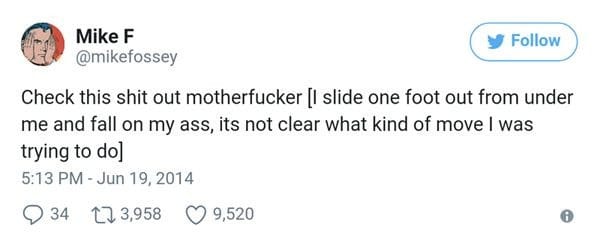
The tweet, from Mike F, reads:
Check this shit out motherfucker [I slide one foot out from under me and fall on my ass, its not clear what kind of move I was trying to do]
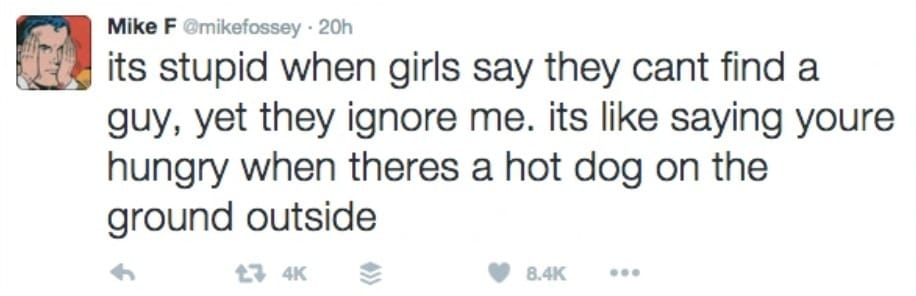
The tweet, from Mike F, reads:
its stupid when girls say they cant find a guy, yet they ignore me. its like saying youre hungry when theres a hot dog on the ground outside
Everything is ephemeral, really. On December 22, 2025, Mike Fossey died. Eight days later, the news hit Bluesky. People shared their favorite tweets of his, including some well known classics I’d seen before (like the ones above). Also, dozens I hadn’t seen. Joke after joke. Many that hadn’t gotten much traction, but that individuals had at the ready because they loved them so much. Some that made me laugh out loud while I waited at the veterinarian.
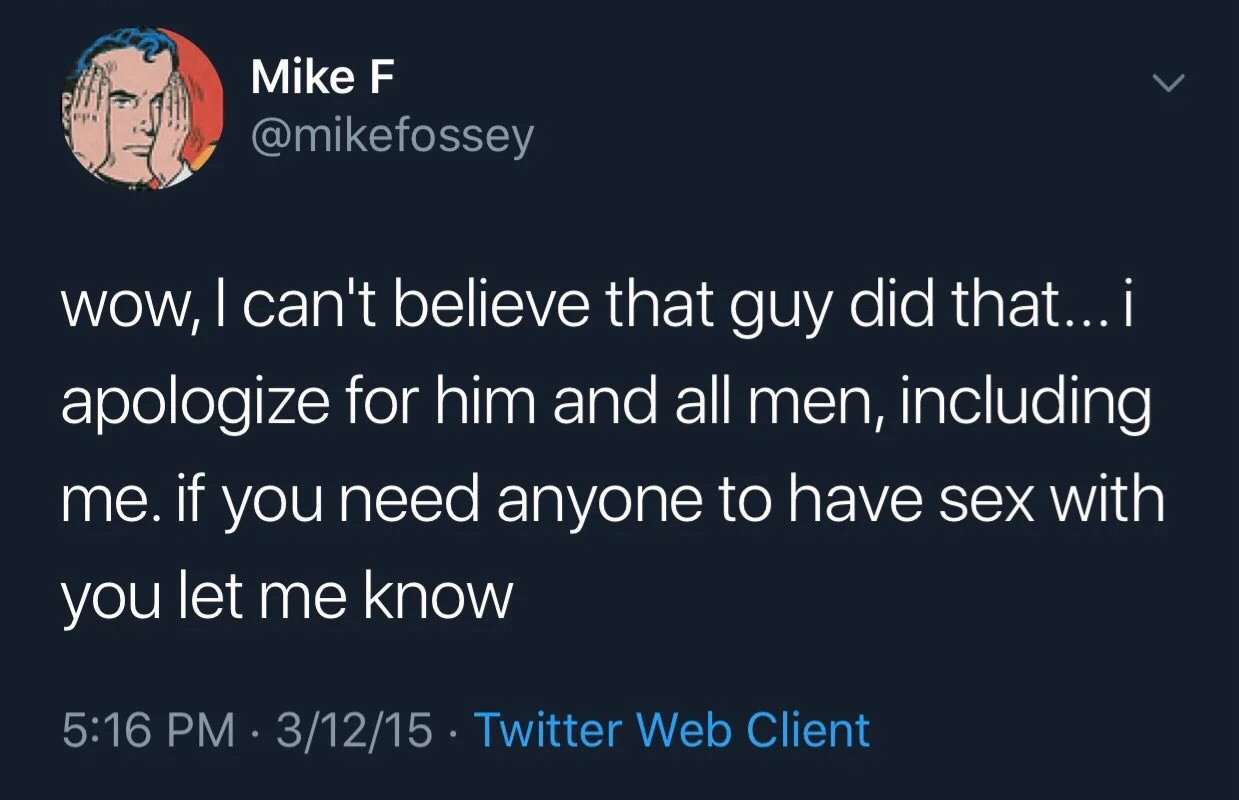
The tweet reads:
wow, I can’t believe that guy did that… i apologize for him and all men, including me. if you need anyone to have sex with you let me know
Someone shared the funeral home’s memorial page, and I saw a guy around my age with a big smile, hugging a dog. The obituary talked about his closeness with his family, and included accounts of his noteworthy professional endeavors. It seemed to have been written by someone with no sense of his prominence online. I wondered how much his family knew about the life he led making strangers laugh by the thousands. By all accounts, he was warm and kind. There were probably lots of people who knew and loved Mike Fossey, the person, and didn't particularly know or care about Mike F, the internet personality.
There were comments on the memorial page from people who did not know him in real life, who wanted it known that Mike F had spread mirth and joy in online spaces that needed it. I cried thinking about how meaningful it would be, if I had lost somebody, to learn that they were so highly regarded, had touched so many lives in a positive way.
On Bluesky, the gravity of his death seemed to free everyone up to talk about his work in serious terms. They called him a writer, not just a poster. They talked about his creative voice, and how much it had influenced the sensibility I’ve been talking about here as Posting Humor. They called him one of the greats.
A lot of artists wonder if and how they might be remembered through their work. That was a sad day online, but it was also moving. I scrolled and scrolled through quotes and replies on several threads about Mike. One far-down reply, with no likes, comments, or reposts, caught my eye. As its own tweet, out of context, on any other day, it would have read as a joke. A good one, even. In context, it felt sincere.
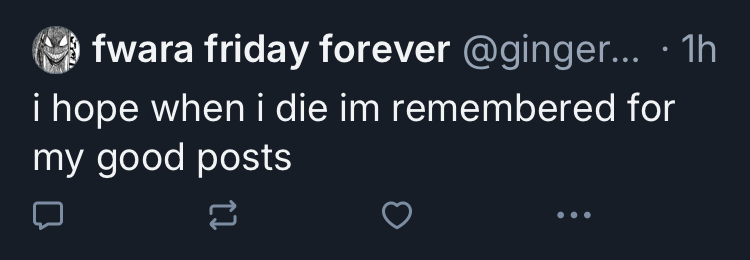

Danny Cohen is a writer and musician from Austin, TX. They make music under the name Mx. Emotion, and their writing has also appeared in Broad Sound, Bright Wall/Dark Room and Wig-Wag.