

By Adam Ansley
There are video games that seem to just happen. That's an obvious statement in these times of infinite Steam and app store releases, but it was true even back when games had to be physically printed on discs or cartridges by real companies and dispersed through gatekept supply channels. There were plenty of games that would just appear on store shelves heralded by, at most, a couple of magazine ads. In the pre-digital era, these games could be anything from a small studio's first big swing, to shovelware, to misfires by major publishers sent out to die. A lot of the time, those releases would be bad or uninteresting, but sometimes a game would have an overlooked spark of something that would turn it into a cult classic or forgotten gem. The most well-known examples of this (yes, well-known cult classic is an oxymoron) would be the early output of From Software; games like King's Field, Shadow Tower, or Evergrace sold tens of thousands of copies in the English speaking world back in their day, but are now beloved fodder for video essayists with millions of views. Those games gained their modern attention thanks to From's later success, but there are hundreds of other games from the pre-social media era with their own unique merits that are still largely unknown, through a combination of luck and some minor fatal flaw. The modern internet will occasionally rediscover one for any number of reasons, but that still leaves most of those games overlooked. Personally, I'm waiting for a famous streamer to pick up Cyberspeed and give it a revival, which I'm convinced will happen any day now.
I go into this because I want to tell you about an early PS2 game called Sky Odyssey. If you've heard of it, you either rented it as a kid or you need to go outside more often. For everyone else, it was a flight game that attempted to straddle the midpoint between arcade and simulation gameplay. The closest analogy I can find is that the game feels like it was supposed to be Sony's take on Pilotwings. My next closest analogy is, "what if Wing Arms was Stuntman," but those are also obscure games and I don't think many people would get the reference. Regardless of analogy, there's so much more that's odd and noteworthy about Sky Odyssey which can't be captured just by calling it Sony's belated Pilotwings 64 killer. Yet, not enough for it to have achieved cult status in its own time.
Released on November 17, 2000 in North America for the Playstation 2, which was itself less than a month old, Sky Odyssey primarily has the player pilot a small variety of propeller planes through 16 levels, with the basic goal of each being to reach a landing strip at the end while flying through some number of floating rings along the way. Most levels have unique mechanics or complications to spice things up, such as needing to land on an aircraft carrier, navigating extreme air currents, mid-level refueling, dropping supplies on small targets, or, more often than not, weaving through increasingly narrow and treacherous canyons and cave systems. The game doesn't have a story so much as a premise, which is that you are exploring a fictional and inhospitable island chain in search of ruins from a mysterious lost civilization. There aren't any narrative twists or turns, you search the islands and eventually land at a lost city with the only supernatural aspect being the impossible weather conditions. In addition to the main scenario, referred to as Adventure mode, there's Target mode where you fly through numbered targets in open zones, a few skywriting challenges in Sky Canvas mode, and Free Flight mode where you can wander around unlocked areas. Those extra modes are more important than you would think, but we'll get to that.
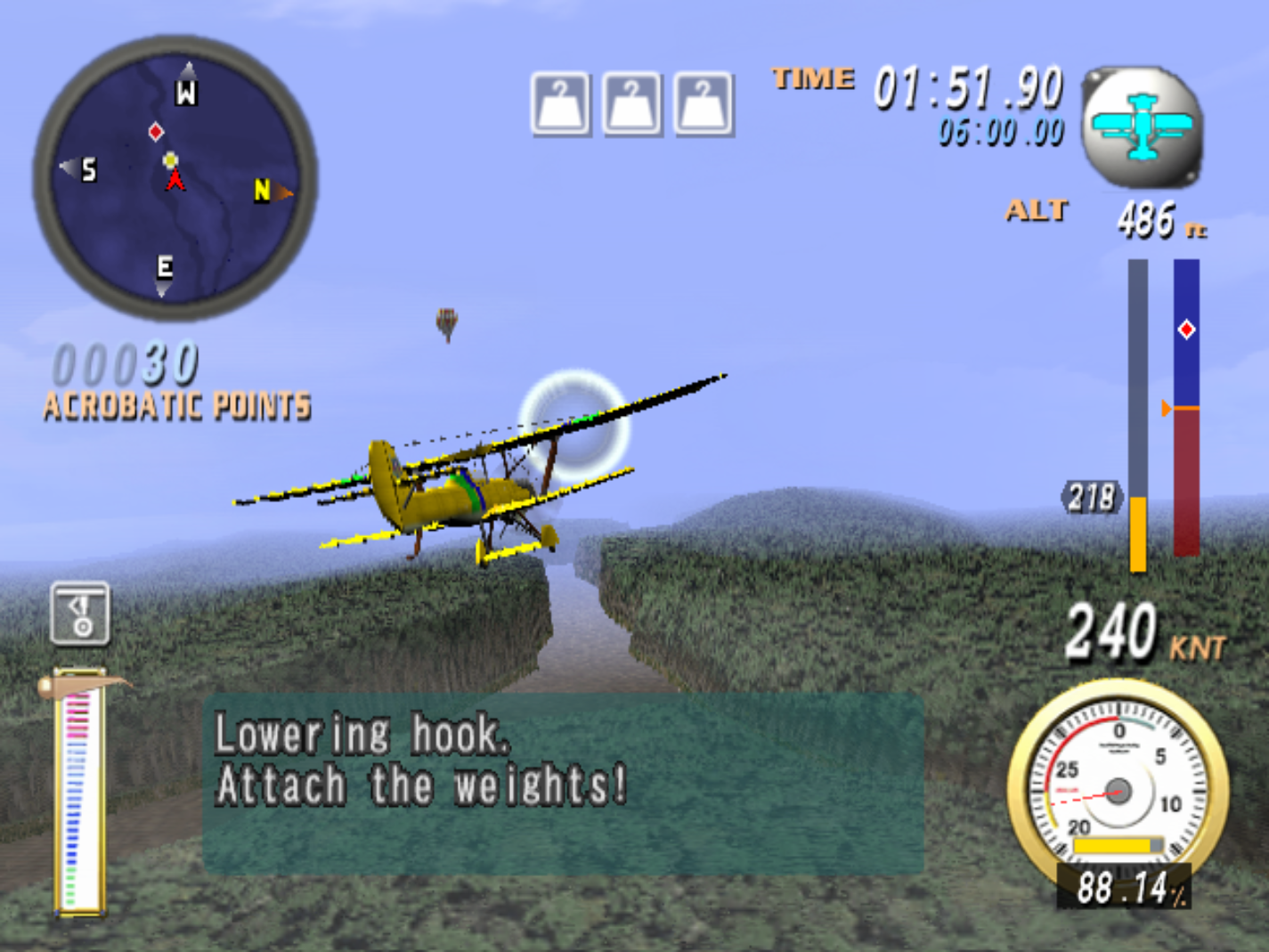
The developers seem to have hung their hats on the game’s reasonably advanced physics simulation. While it isn't a grognard sim like Microsoft Flight Simulator or F22 Total Air War, the game puts a lot of effort into the weather effects and plane handling. It makes an attempt at modelling the impact of wind, temperature, and air pressure on your plane while also demanding aerobatic maneuvering, seemingly in an attempt to invoke cultural memories of those daredevil stunt pilots of early flight. That could also account for the bizarre array of planes to choose from. You start with the selection of a Fairey Swordfish, Messerschmitt bf-109, and an apparently fictional pulse jet plane creatively named Test Type. There are also an additional eight unlockable aircraft, including another Messerschmitt, an F4U Corsair, a Kawanishi N1K-J Shiden (which you might recognize from Godzilla Minus One), and the upgraded Shiden Kai. These planes are from WWII, and are included with no rhyme or reason beyond aesthetic choice. The remaining four unlockable aircraft are novelty options obtained through severe criteria, which are an F-117 Nighthawk, what seems to be a modified Wallis WA-116 Autogyro, and finally Silver and Gold UFOs. In the end, the plane roster comes out to a decent size with plenty of variety despite being thematically bizarre; yet, most people's first playthrough of the game will be spent in the Swordfish, the only biplane of the group and also the plane featured on the box art.
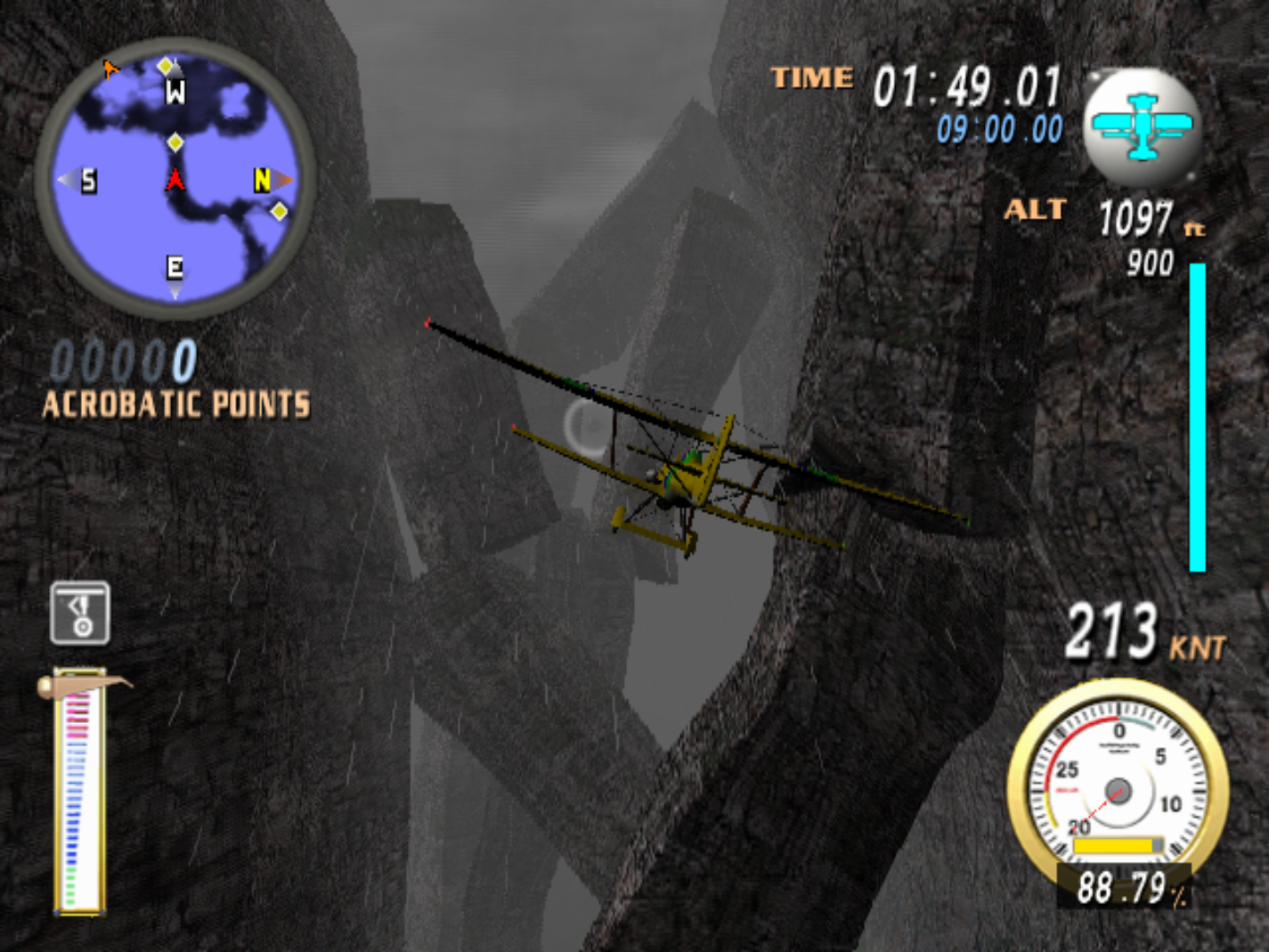
Really, the aircraft handling feels like it was designed with biplanes in mind. The level of importance placed on maintaining air flow over the wings is something that you would need to pick up on quickly, with even basic pitching and rolling proving treacherous to the careless. The simulation ambitions of the flight model are balanced by the more casual interface, with a control setup that would have been familiar to anyone who played older console flying games. With this being a very early PS2 title, it offers both old-school d-pad and ultramodern analog controls. In my experience, the d-pad offers better precision but slower movement while the analog offers snappy movement but squirrely control. I wound up greatly preferring the traditional d-pad method, since the levels themselves usually demand very precise maneuvering with enough time for set-up.
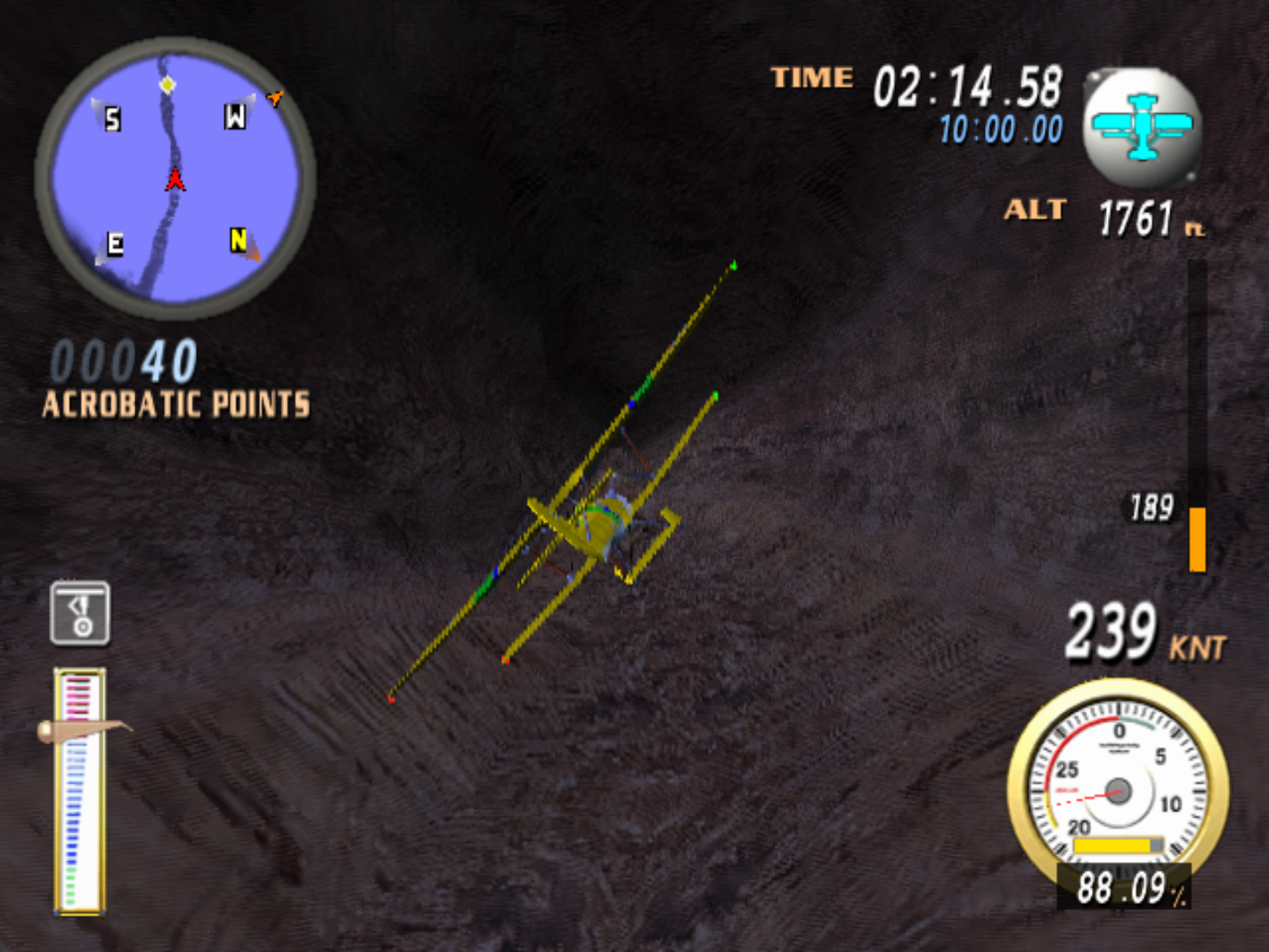
Most of the levels in the main Adventure mode are laid out with slow, sharp turns where you thread the needle through various hazards, demanding a kind of high maneuverability and low stall speed that is at the core of biplane aerobatics. This aspect leads into the game's limited acrobatic scoring system. While the levels are mostly scored on completion time, number of rings flown through, and plane damage, you can score additional points by performing a few different tricks. One of the missed opportunities with this game is that there are relatively few moves that count towards acrobatic points. Basically, you're scored on barrel rolls, low flying, barrel rolls through rings, and low flying while upside down. You can easily achieve an A-rank on any level just from hitting every ring and landing in a reasonable amount of time, but the acrobatic bonus is the key for A+ and circled scores, along with some of the plane unlock criteria. Though, with the severity of weather effects and narrow passages this game throws at you, the acrobatics system doesn't really apply at all to an initial casual playthrough.
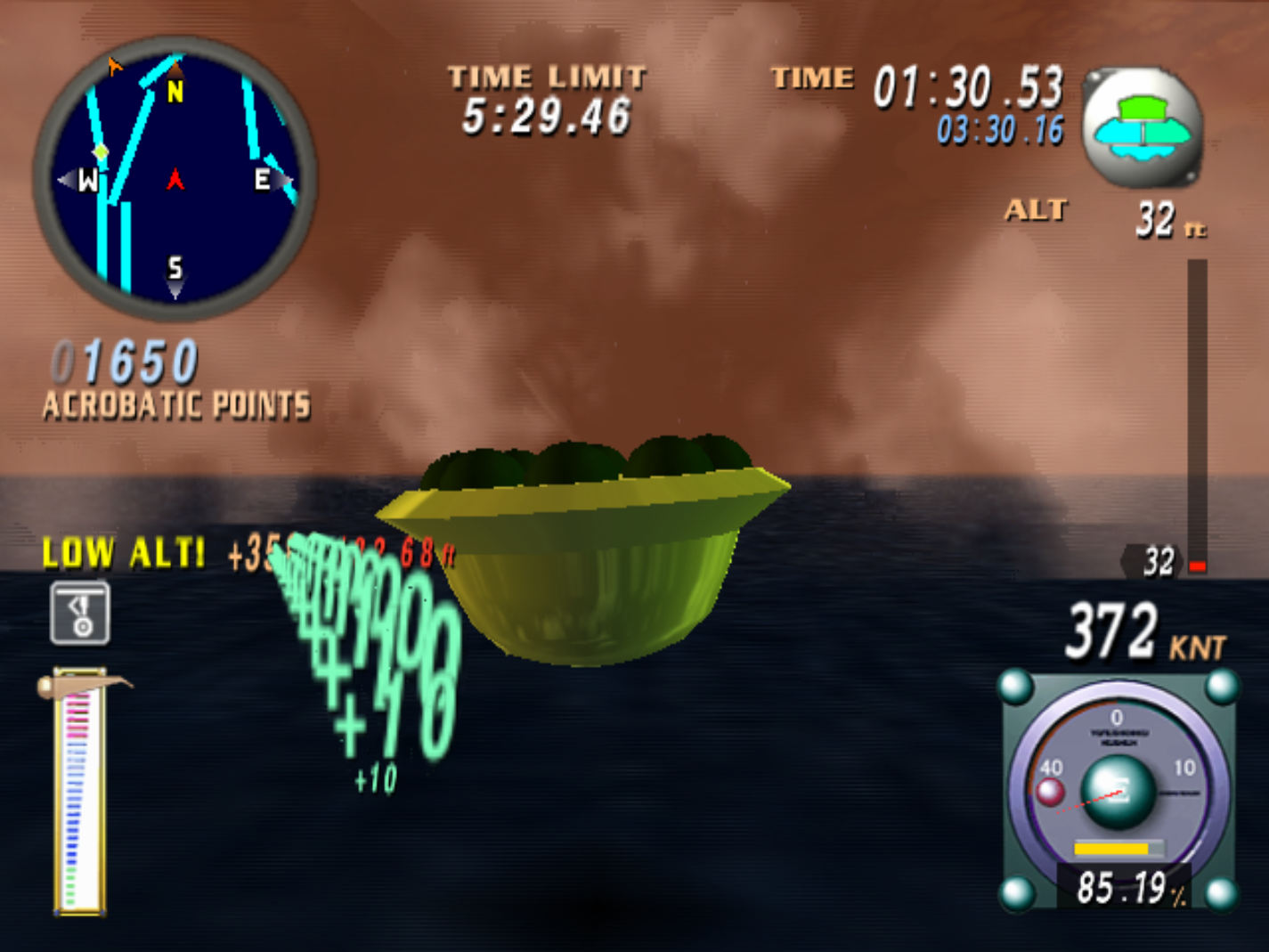
The level grading in Adventure mode feeds into a different underutilized system, plane upgrades. When flying with any of the starting three planes, you can unlock new parts that upgrade or alter the flying speed and handling characteristics of those planes whenever you clear a level with a B grade or higher. There are more unlockable parts per plane than there are levels, and those unlocks persist between playthroughs of the Adventure mode. Now, the reason you would play through that mode more than once is because there are three different final levels, which are unlocked depending on the order you play the levels leading up to it. All of those three potential final levels are bastards, but you'll replay the Adventure mode several times if you want to collect them all. In-game, the only real benefit to doing this would be to unlock each of those three routes for the Free Flight mode, which loads all of the levels together into an interconnected open world that you don't really do anything with besides fly around aimlessly. High scores on each level are saved between Adventure mode playthroughs, so you can go back as a kind of score attack and to break the game with the sillier unlocked aircraft. As an example, a level where you need to perform mid-air refueling can be sequence broken by bringing the F-117 or either UFO, any of which can fly fast enough to reach the end on their initial fuel load.
Target mode is the second and less complicated scenario of the game. This is a run-based mode with an arcade style branching level path where you play five levels diverging from one start point and converging again at one end point. Each of these levels takes place in an open zone with some amount of numbered floating rings in two colors and two runways also of those colors. The goal of each of these levels is to fly through a certain number of rings, with color and numerical ordering giving extra points, and land on one of the colored runways, with your choice determining how you move along the branching level path. Instead of a letter grade, each level in this mode gives you gold, silver, or bronze medals based on performance. These medals are tallied up at the end of a run and can be exchanged for permanent upgrades that apply to other modes. These are minor additions like adding a radio to Free Flight or unlocking a “secrets radar” in Adventure mode that marks Shinden parts locations on the minimap. The main thing to do here is to route both an optimal level path for your choice of plane and optimal flight paths in each level so as to meet the stringent criteria for unlocking the more game breaking aircraft.
Sky Canvas is the most straightforward of the modes. There are ten short levels where you dispense smoke in marked patterns to draw something in the air. The rings and orbs you need to fly through can be restrictive and precise, so this is the closest the game gets to just being Pilotwings. The first five levels are simple and straightforward to get high scores on (this time graded numerically out of 100) and the back five require enough from the player that I was only able to reach scores over 90 when using the Shinden. The unlocks from this mode aren't as useful as they seem like they should be, and it ends up feeling superfluous.
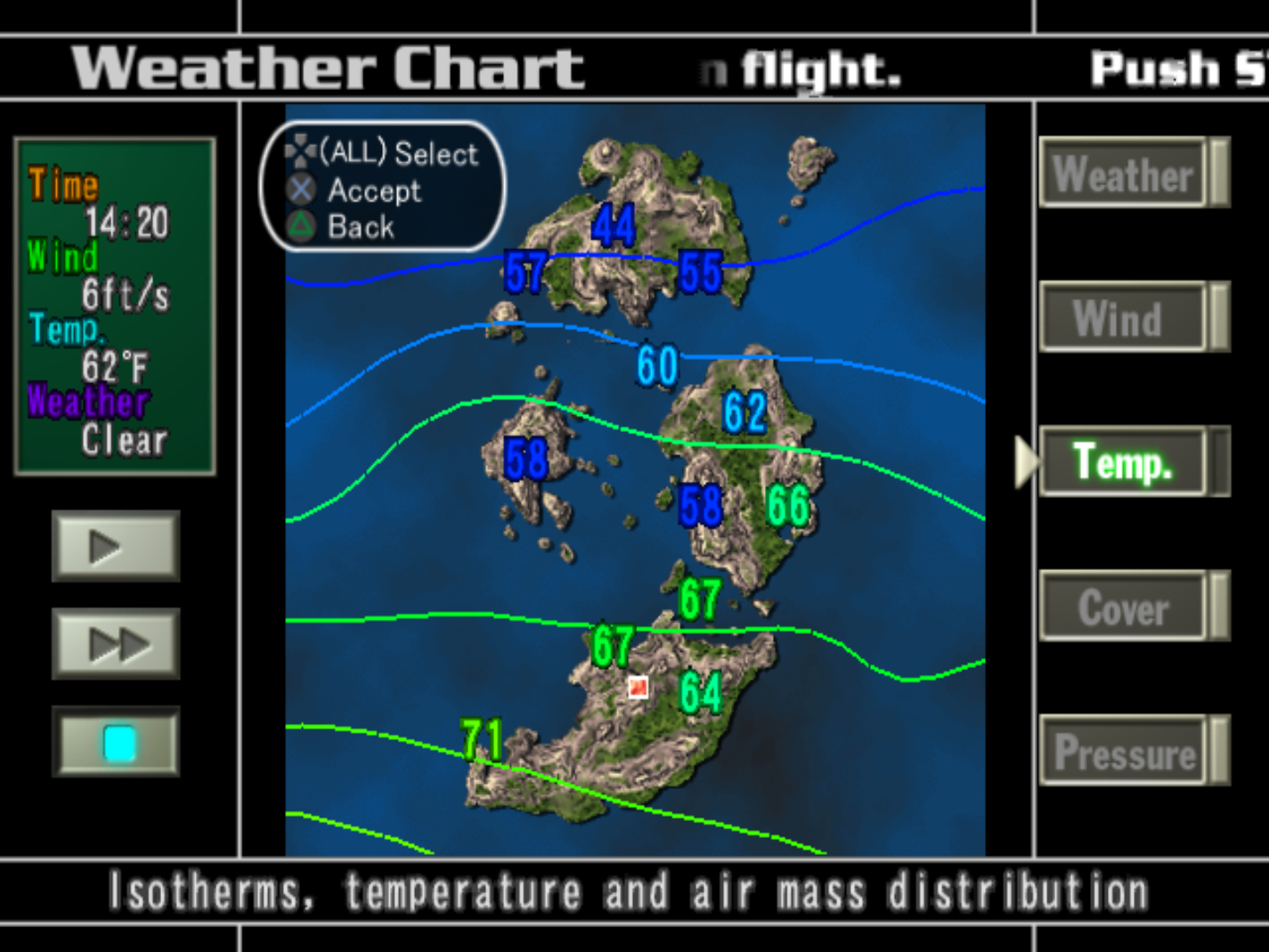
All of these modes feel more loosely connected than I would have wanted, especially considering the fact that everything takes place in segmented chunks of a massive, coherent open world. That isn't even including the seemingly complex systems for weather changes and a day/night cycle that is thrown into the Target and Free Flight modes with seemingly no practical effect. Especially in Target mode, where you can fast forward time to target ideal weather conditions for a level, only for the weather to be mostly pre-set anyway. It feels like at some point early in development this was intended to be an open world game where the various mission types would be accessed in the world. If that had been implemented instead of this piecemeal approach, then this game truly would have been something noteworthy, maybe enough to attain cult status. Instead, what we got is quite good within the standards of the time, but not something that burrowed its way into many people’s minds.
As an audiovisual experience, there isn't much to look at in Sky Odyssey, even by the standards of its contemporaries. The draw distance isn't what you would want from a flying game, the textures are kind of rough, and the environments are extremely empty. For my part, I'd say it holds up well in comparison to PS2 launch titles such as Orphan, Gungriffon Blaze, and Summoner. If you couldn't tell, I'm being a bit of an ass with those comparisons. More seriously, the game is clearly of lesser visual quality when put up against some other launch titles, such as Armored Core 2 or Ridge Racer V, and the later Star Wars™ Starfighter, which came out in early 2001. Still, I'd rather play Sky Odyssey over Armored Core 2 or Starfighter any day of the week. Practically, this game is designed around the limited draw distance, while the muddy textures only cause problems on one or two occasions during gameplay.
What's far more notable is the audio. I'm not referring to the sound effects, which are about par for what this game is trying to do, but instead the music. If there's any one thing that will stick with you long term from playing Sky Odyssey, it's the music. Each of the individual tracks are relatively short in comparison to the 5 - 20 minute length of any given Adventure mode level, but those tracks cleanly convey a specific feeling to match the intended mood of any given level segment. The simple tracks are woven together throughout the levels based on event flags. So, when you start a level by taking off from a runway in a clear, open field, the whimsically adventurous track will play; but when you reach the point where you're dodging boulders from a collapsing canyon the music will seamlessly fade in a more tense, serious track. The longer levels can cycle between several tracks to emotionally navigate you through your journey. You can tell this was the intent from the track names, with labels such as, "Fretful", "Mystery", "Courage", "Anxiety", "Freedom", and so on. It helps that the development team seemed to have known what they had on their hands because the music is mixed above the engine drone to keep it at the front of the soundscape. It's all composed quite well, but not in a distracting way, landing right in the unconscious zone of the player's experience as you have to lock in to wrestle the plane into unreasonable maneuvers.
The in-level music tracks aren't even the most noteworthy part of this soundtrack. There's a mission briefing at the start of each level showing a low-poly rendering of the intended route with the driest voice over of all time explaining the goal, gimmick, and conditions of the flight. That would be an odd vibe on its own, but those briefings are backed by music tracks that are very different from what you would find in video games from the time. They involve highly dramatic orchestration with what sounds like a Bulgarian folk choir. It feels wildly out of place for the rest of the game, but also kind of slaps in an off-putting way. Now, if you're not Bulgarian and consume Japanese media you might recognize the Bulgarian choir inspiration in those tracks from Ghost in The Shell or the Nier game series. If that's the case, then you'd be wrong. You're supposed to recognize this style from the hit 2005 PS2 game, Shadow of the Colossus, because Sky Odyssey shares a composer with that game in Kow Otani.
While Otani is most remembered for that later game, he had been a well-regarded presence in the Japanese film and animation industries throughout the '90s, with his highest profile works being Mobile Suit Gundam Wing and the Gamera trilogy. On a side note, I listened to some of his music from those Gamera movies while preparing for this article and came to a realization with some of those tracks that maybe Otani phoned it in more than I thought with Sky Odyssey. Regardless, with hindsight you can hear him working through some ideas that would later be seen in a more mature form in Shadow of the Colossus.
Now, if Sky Odyssey is truly this interesting conceptually, systematically, and musically, how did it fall so far down the memory hole and end up as a forgotten game?
When a good game goes down the memory hole so thoroughly, the first question is, "why?" In this case, the biggest culprit seems to be the complete lack of marketing it received. No trailers, magazine ads, previews, E3 coverage, or any piggybacking on Sony's PS2 ads. It basically just popped into existence on store shelves one day as if it were a piece of low effort shovelware. Contemporary reviews themselves tended to be short and perfunctory, with the exception of IGN, whose reviewer, David Zdykro, got really into it and gave the game a 9 out of 10. Looking at other reputable publications of the era, Andy McNamara gave it a 7.75 and the late Ryan Davis gave it an 8.3. Personally, I would probably have given Sky Odyssey a score somewhere between Davis and Zdyrko, largely because this is a neat game that exists inside my wheelhouse. The Fall of 2000 was a hectic time for video games, to the point where a pretty good unheralded game could easily be ignored. This was obvious even at the time, since it won “Best Game No One Played” from IGN during their year-end awards. Looking at popular impact, sales information is dubious-to-nonexistent, with the most I could find being an unsubstantiated 320k worldwide sales figure. If true, that would be a normal number for a bottom-tier PS2 launch title.
So, it isn't that absolutely nobody played Sky Odyssey back in the day, or that no one remembers it. In the course of preparing this article I encountered more than one person who recalled childhood memories of the game, with the editor of this very publication being one of them. Media can be forgotten not only because no one experiences it in the first place, but also because most people who do experience it move on without feeling the need to revisit and discuss it. As a random example, the Jet Moto video game series sold over 3 million copies in the late '90s, but unless you were there at the time you might not have any idea what those are. If something that successful can drop entirely out of relevance, there isn't much hope for more modest releases surviving in the collective memory without lucking into a cult favorite status.
That cult status requires a piece of media to have some kind of evergreen quality in order to stick. The King's Field series, with their conversion of 1980's computer RPG concepts into low-fidelity action gameplay, presented an experience unique enough to worm into the minds of tens of thousands of hardcore enthusiasts for their 20 years of irrelevance before being "rediscovered" when From Software hit the mainstream. Those games were cult classics until normal people heard of them, and each game that has a cult following has some kind of hook that you won't find anywhere else.
Sky Odyssey doesn't really have a strong enough hook to cut it as a cult classic. Microsoft Flight Simulator had sucked all the air out of the Flight Sim genre, and more arcade-y Flight games were dominated by the Ace Combat series and its copycats. The niche of pacifist, arcade style flying had been filled twice before by Nintendo's Pilotwings series, and this game's more physically demanding take on that format didn't give a strong enough impression to foster a grassroots fanbase. That failure to catch either the zeitgeist or a devoted niche happens to good games all the time, in every era. As a more modern example, you might not have played Battle Chef Brigade, but you really should have. Without catching with a large or vocal enough audience, Sky Odyssey has landed firmly into forgotten gem territory, joining hundreds of other titles waiting for a renaissance. In this case, I believe that flying games would need to come back into vogue in order for this thing, along with several other games in that wider genre, to garner a reevaluation.
For such a rediscovery to happen, there needs to be the ability for new people to experience this game. Keeping knowledge alive about the forgotten gems of any form of media requires committed enthusiasts and archival efforts. While that first requirement is easy to fulfill for video games, the second is far more perilous. The secondary market for old games is plagued with speculators and dwindling supply, and there aren't really any academic or comprehensive libraries of old games that can be easily or legally accessed. None of those issues even grapple with prohibitive hardware and interface issues inherent to dealing with old video games. This means that in order for an average person, such as you or I, to access a game like Sky Odyssey, we would likely need to do so through legally dubious .iso files and emulation. That turns discovery of forgotten classics of the artform into an act of outlaw banditry, which is an unacceptable state of affairs. The medium improves and flourishes when both creators and the consuming public are knowledgeable about the successes and failures of what came before; with Sky Odyssey serving as a good example of the kind of game people should, but don't, know about.

References:
- https://www.videogamemanual.com/PS2/Sky%20Odyssey%20(USA).pdf
- https://www.mobygames.com/game/3619/sky-odyssey/credits/ps2/?autoplatform=true
- https://gamefaqs.gamespot.com/ps2/429819-sky-odyssey/faqs
- https://archive.org/details/game-informer-issue-92-december-2000/page/94/mode/2up
- https://gamefaqs.gamespot.com/ps2/429819-sky-odyssey/faqs/12725
- https://www.ign.com/articles/2000/11/18/sky-odyssey-ships
- https://web.archive.org/web/20211217171035/https://www.ign.com/articles/2000/11/17/sky-odyssey
- https://web.archive.org/web/20010208103547/http://ps2.ign.com/news/30696.html
- https://www.vgchartz.com/game/24643/sky-odyssey/
- https://retroachievements.org/game/22607
Adam Ansley writes about old video games on his site, fifthgengaming.blog, where he has set himself the sisyphean task of reviewing every 32-bit console game released in North America. He also contributes to the Deep Listens podcast network, appearing as a guest on Off The Deep End, where he discusses obscure role-playing games, and hosting the show Chariots of the Pods, which is a watchalong retrospective of the Stargate franchise.