

By Nina Luther
In the opening scene of Secretary (2002) we meet Lee Holloway, played by Maggie Gyllenhaal, a neurotic, quiet woman, just released from a mental institution. Later in the film, we find out why she is there: an attempt at self-harm that went awry. The thing is she doesn’t actually want to leave. What we learn early about Lee is that she craves structure and order. A typing class brings her closer to this ideal paradigm and is in fact the first time in the film in which we see Lee happy.
After receiving her first award in typing, she promptly applies to a law office, found in the job listings section of the newspaper. Before this scene, we see her self-harm at least once with a hot tea kettle, which is hard to watch. However, the pure feeling of release on her face is important; It’s why she does it. She rushes herself into the “real world”, away from her childhood bedroom of bright purple walls and mermaid snow globes. Even her self-harm kit is housed in a box covered with glittery stickers with one of her tools, a ceramic ballerina with a sharpened slipper. But this law office, owned and operated by E. Edward Grey, is somehow reminiscent of her sensibilities, sophisticatedly kitschy with various wallpapers and intricate woodwork. She walks into Mr. Grey’s office and finds him administratively lost, having just apparently ousted his previous secretary. It is pouring outside when they meet and the shot implies that this office will be a reprieve for Lee, as she finds cover from the rain. Their relationship forms into something strangely romantic and healing for both parties.
The typewriter is essential to Secretary: we hear typing sounds during the pre-credits and see the type element in action. In almost all the film posters, the title is in stylized typewriter-like font. What stands out about these details is that the movie debuted at the Sundance Film Festival in January 2002 and had its theatrical release that September. Computers had taken up an increasing share of both homes and offices by then. We can safely assume that a desktop machine (or a whole office full of them, even) is not out of Mr. Grey’s financial scope either, especially after seeing his high-life home where he lives alone. In fact, he tells Lee during the interview that the office only uses typewriters. Though the office does have a computer as shown while Lee and Mr. Grey are in one of their usual (or unusual) trysts.
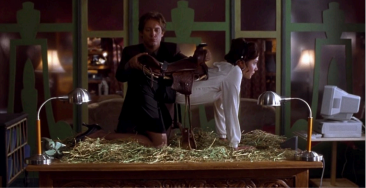
Mr. Grey and Lee Holloway in the film Secretary
Why is the typewriter such a major component of this film? This may be because the film is a loose adaptation of a story by Mary Gaitskill in the collection titled Bad Behavior, published in 1988. Unlike Secretary, the story it’s based on, Minority Report, has little resolution. We as readers are not provided with much of the lawyer’s feelings, who makes advances upon the main character. A critique of the film, by Gaitskill and others, is the additive of a “happy ending,” to an otherwise mundane understanding of life and sexuality. The character in the story, years after the interactions, alternates between desire and disgust at the dreams and thoughts that follow her surrounding these past interactions. She is both aroused by the degradation and angry at the assault from a boss who was much older than her and, of course, was also the benefactor of a heavily weighted power dynamic in his favor. Though Secretary may have some key differences, mostly in the ending, both versions explore Lee’s changing attitudes around her sexuality. And the change is triggered through typing.
The typewriter has long been lauded as revolutionary for writers but especially for women and their role in the workforce. We see that Mr. Grey mainly hires women for the job as secretary, though seems to have a hard time keeping one. In fact, we only see Mr. Grey use a typewriter once: when he writes a shame-filled apology to Lee after ejaculating on her back. The irony is that, at this moment, Lee is the happiest she’s ever been. She is opening up to her pain publicly and without shame (especially during the film’s iconic ending). For Mr. Grey, using the typewriter is abnormal, a moment of vulnerability. All of Lee’s life, she has attempted to hide this vulnerability, quietly self-harming while her alcoholic father wreaks havoc on her family. But now, at work, Lee is allowing herself to be punished. Lee’s use of the typewriter is revolutionary for her in a different way.
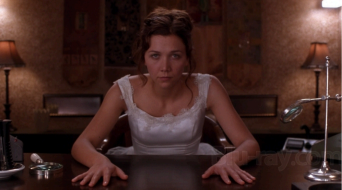
Lee sitting at Mr. Grey’s desk
The typewriter was engineered in 1867 but became common-place after the 1900’s. At the time, it was the pinnacle of efficiency. The typewriter used in Secretary, the IBM Selectric, itself revolutionary for its time, introduced the element whereas the original machines had individual typebars [editor's note: this is where the name of the magazine comes from] which were difficult to maintain and slowed typing down. It allowed more leniency with the machine, offering two different correction tapes for typos and the ability to change the pitch size. The IBM Selectric was likely chosen for the film because it was a very popular office model throughout the country, but it also represents the world widening for Lee and the added intention of her typos.
The Selectric is actually the same model used in Mad Men. It isn’t historically accurate in Mad Men however. They were chosen based on look and because they were quieter than the vintage ones. Ultimately, the time period that Mad Men takes place in has already experienced the shift of women in the workforce, enabled by the typewriter. The show clearly displays how this does not equate to equality, in the workforce nor at home. But Secretary doesn’t revolve around themes of workplace sexism though it could be perceived as so. Initially, Mr. Grey avoids exposing Lee to his controlling behavior, which he seems to have exerted on her predecessors (as seen when she first enters the office) but his cool fades once he sees her on a date with Peter, a potential beau. This could all be interpreted as sexual harassment, especially the questions he asks about their date: “Did you have sex? What’s his name?” Similarly with the first incident of spanking: It doesn’t seem likely that Mr. Grey would know that she would enjoy this arrangement without first crossing the line. Upon rewatching Secretary, these morally ambiguous interactions seem to be an awkward translation from the original story, which is notoriously not a romance.
It’s a point of pride for Lee that she gets the highest score in her typing class. But Lee is never perfect at her job, no one is. Women were expected to be and still are. In a way, though the use of the typewriter opened up the world for women, it seemed to also turn them into machines. In an early typewriting manual, cited by Bruce Bliven in his book, The Wonderful Writing Machine, the typist is automatically female-coded, her body described impersonally with deliberate movements meant only to further the task at hand. As Judith Butler states in her essay Performative Acts and Gender Constitution: An Essay in Phenomenology and Feminist Theory, the identity of the typist and thus the woman, is defined by the repetition of acts that go into the work and ideally they become efficient and mechanical, like a robot (1988). Lee’s consistent typos contradict this and are eventually intentional; the machine is made to be broken. Even when there is no typo, the typewriter is involved: much to Mr. Grey’s delight, she places a dead worm on machine paper and puts it in an envelope addressed to him.
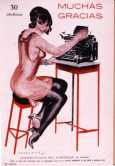
Secretary is not the first occurrence of the erotic nature of typewriters. Since the production of the typewriter and its connotation with working women, various illustrations of typists were released. These drawings either promoted the idea of equity or disdain for women who were accused of leaving their children and husband behind. A popular depiction was the Gibson Girl, an independent woman meant to portray the feminine ideal. The dehumanization of women through male representation progressed into erotica surrounding the use of the typewriter, either for herself or an employer. Commonly, the typewriter was coyly placed in between her legs with a flirty look at the viewer. The poses in many of the drawings also imply a desire for praise. These depictions more than just made the role of typist inherently sexual but further degraded women’s role in the workforce especially when it was seen as a threat to men who had previously worked clerical duties. Secretary may play into the stereotypical role of a typist but subverts the perceived powerlessness of her role. Like Roger Ebert writes in a favorable review, Mr. Grey and Lee’s relationship may seem hostile but there are sly signals passed between them and us, the audience, letting us know who’s in control.
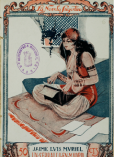
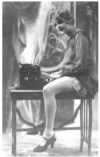
Mr. Grey is slow and thoughtful and the signs of obsessive-compulsive disorder are clear. We understand why he has lost so many secretaries. It is comedically apparent with a permanent fixture under the office sign reading “Secretary Wanted,” that is nearly bigger than his name. His shame is in his inability to not dominate, that he also can’t help but enjoy it, his submissive perfectly placed in the role of secretary. However, Lee is the perfect victim of his neuroticism because she’s not a victim. The structure and order that she desires is presented in the shape of Mr. Grey and a typo circled in red. Lee tries to please Mr. Grey as he begins to descend upon her but she only falters more. The typos keep coming. The red marker is in action.
Peter is the foil to Mr. Grey, that much is apparent. He is what her family expects for her and makes his appropriate appearance at Lee’s sister’s wedding. His parents are alarmingly supportive of a prompt marriage and conception. We know Lee wants to want this. She wants to be “normal” and domestic like her sister. In this sense, the workplace is revolutionary for her. We see Peter in the law office only twice. The first time, we as viewers are as alarmed by his presence as much as Lee is. He doesn’t belong there nor in her fantasies. The second time, Lee sits in Mr. Grey’s seat, now the boss of her life. Peter tries to will her violently away to no avail. Lee is willfully submissive, almost dominant in her desire to play this role with Mr. Grey. He is relieved to unleash control and we understand that Lee has always had it. This duality lies at the heart of BDSM; Her deep trust in Mr. Grey brings him the connection he’s been lacking while empowering them both.
The movie itself has the tactile pleasure of a typewriter. Lee’s room and Mr. Grey’s office are both richly textured and decorated with different fabrics, colors, and light, Mr. Grey utilizes a small machine with buttons and levers to care for his orchards, and even the way Lee carefully places her tools in front of her before self-harming. Debbie Harry says in Videodrome, a Cronenberg film many also associate with BDSM, “We always want more, whether it’s tactile, emotional, or sexual…” Secretary has it all. Though Videodrome certainly plays into sexual torture, Secretary has no message or ulterior motive. The message is not explicit at the very least; Two lonely people have come together through a love and desire that’s unique thanks, in part, to the typewriter.
