

By RS Benedict
In 2003, a worker at the new Oshkosh, Wisconsin branch of a retail chain called HobbyTown snapped a couple of pictures of the building during renovations and posted them on the store’s website. One image, shot at a Dutch angle, shows wall-to-wall beige carpet, fluorescent ceiling lights, dingy yellow wallpaper, and a series of halls and entryways that somehow lead nowhere and everywhere at once. The worker captioned it, “Above is the original view of the East (Oval) room. Notice no windows are visible?”
Sixteen years later, that image ended up on 4chan with a new caption:
“If you’re not careful and you noclip out of reality in the wrong areas, you’ll end up in the Backrooms, where it’s nothing but the stink of old moist carpet, the madness of mono-yellow, the endless background noise of fluorescent lights and maximum hum-buzz, and approximately six hundred million square miles of randomly segmented empty rooms to be trapped in. God save you if you hear something wandering around nearby, because it sure as hell has heard you.”
The post became a wildly popular copypasta at a time when the internet was obsessed with liminal spaces. It inspired many derivative works, one of which—a series of spooky YouTube videos by Kane Parsons debuting in January 2022—eventually turned into a feature-length movie successful enough to beat Baby Yoda at the box office on its opening weekend.
Liminality—being at a threshold between two states—has been a cultural obsession and the source of delirious anxiety since long before the internet declared it a hip aesthetic. Liminal spaces like entrances or bridges, liminal times like midnight or New Year’s Eve, are woven together with important folklore and rituals. Horror, especially, loves the space between spaces: gateways to Hell, monsters that straddle the line between living and dead, places where the veil between the material world and the spirit realm is thinnest.
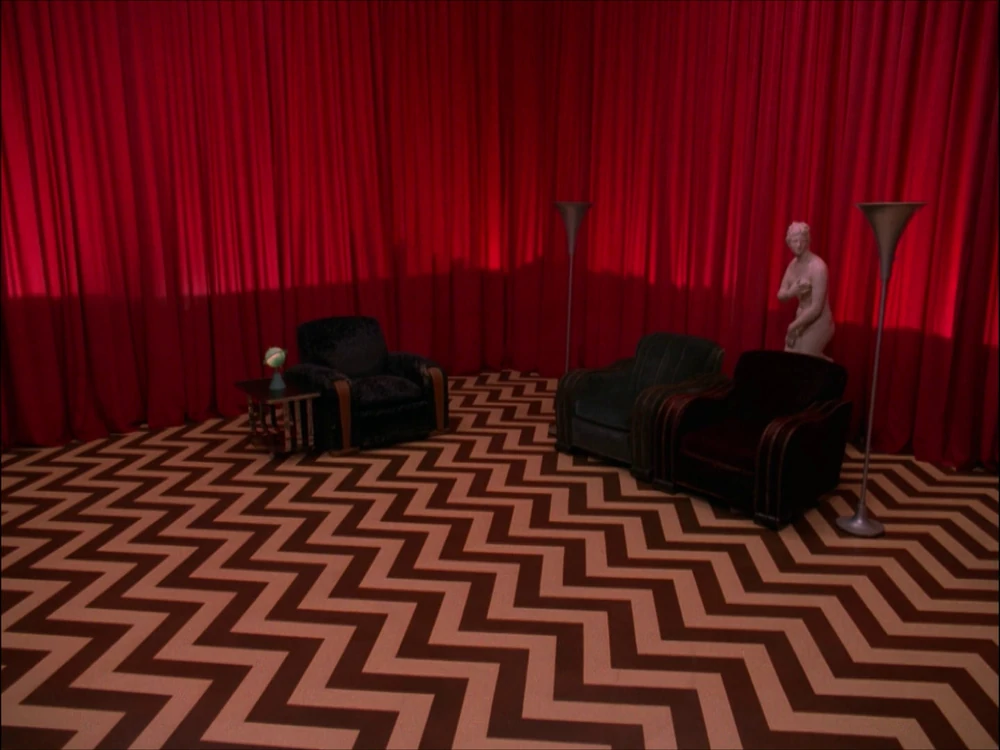
One can find precursors to Backrooms in works like The Shining, The Yellow Wallpaper, House of Leaves, Carnival of Souls, Twin Peaks, and of course the ancient story of the Labyrinth and its Minotaur, stories where a character becomes uneasily stuck in an in-between place, sometimes with broken geometry, sometimes with a monster.
In these stories, though, there is usually a real or implied exit, however inaccessible. There is a starting point and a destination, or at least a center. The existential horror of Backrooms is that it goes nowhere. It has no heart.
A liminal space exists to escort you from one place to the next. You’re not supposed to stay there. If you’re sleeping in a doorway, something is wrong.
Contemporary North American spaces—from building interiors to manufactured cityscapes—overwhelmingly want to shove you through and send you somewhere else. Our third spaces,places where you spend time and hang out with other people outside of the home and the workplace, are evaporating. Fast food restaurants are designed to make you eat and leave quickly, or to drive through without stopping at all. Roads are for cars to traverse, not for pedestrians to stroll down, window shopping, stopping at a sidewalk café to sip an espresso and contemplate life. Benches in public parks are deliberately made uncomfortable, fountain ledges covered with spikes, to deter anyone from sleeping there. It’s called hostile architecture. In America, even the furniture hates you.
Careers are more liminal, too. Long gone are the days of working at one company for decades until retirement. Job hopping is normal now; it is often the only way to get a raise or a promotion. Layoffs are common, especially in tech. Even working just one full-time job seems like a quaint throwback to a bygone era; today, more people are working multiple jobs than any point in the last 30 years.
Something similar has happened to housing. The average age of first-time home buyers rose to forty in 2025, which means Americans can expect to rent for about twenty years of their adult lives. That means moving from place to place every couple of years to escape rising rents. A popular product for contemporary interior decorating is peel-and-stick wallpaper, designed to be removed when the tenant has to leave for the next apartment. Just yank it down and erase any evidence that you were ever here.
Home ownership is no antidote to liminality, either. A house is an investment to resell for profit, not a place to put down roots. Designers nudge homeowners toward bland whites, beiges, and Millennial grays during renovations. Anything too bold, too colorful, too you will make the place harder to sell to someone else. One of the biggest trends in bathroom design is white brick-shaped tiles that make the shower look like it belongs to a 20th century mental institution. They’re called subway tiles. Another liminal space.
Nearly every space we inhabit—physical, financial, emotional—is liminal now. It exists to get rid of us. And yet we’re living in it. Something is wrong.
This is not the free-wheeling wandering of the Bohemians, nor the nomadic pastoralism of the Sámi. This is arbitrary and coercive and soul-sucking.
Something is terribly wrong.
Backrooms is set in 1990, in the Bay Area. But this is no Stranger Things-style nostalgia bait. No one’s wearing cool 1990s fashions, grooving to Nirvana, snacking on Dunkaroos while grinding on rollerblades. The 1990 of Backrooms is decidedly shitty.
No one is having a good time. Our protagonist, business owner Clark, sleeps on display furniture in his failing store; his ex-wife kicked him out of the house. He huffs and collapses miserably while trying to film a low-budget ad for local television. He once dreamed of being an architect. His therapist, Mary, sells self-help tapes in late-night infomercials, but she hasn’t overcome her own childhood trauma around her hoarder mother. She sleeps alone, too.
Even outside of the titular backrooms, the scenery is alienating and ugly: shitty furniture store, shitty parking lot, shitty condo, shitty therapist’s office, shitty motel village, shitty prefab suburban house torn down to make way for what will probably be an equally shitty tower. Every material surface is artificial and looks flimsy or itchy. Nothing feels warm or inviting or human.
So why 1990? The past is a foreign country, as David Lowenthal wrote; an exotic setting makes an effective home for an unsettling drama. And 1990 is a good year for found footage in the analog horror vein. A chunky low-res 1990-style video filter was probably a handy way for Parsons to hide any weaknesses in the computer animation of his original YouTube series.
But 1990 was a liminal time. The Berlin Wall had gone down the year before, and the USSR was in the process of collapsing. Apartheid, as referenced by an unlucky supporting character’s t-shirt, was ending in South Africa. The Cold War was drawing to a close, leading to the era Frances Fukuyama declared The End of History in a 1989 essay. ARPANET was on its way out, and its successor, the internet, was on its way in. The world was becoming more connected, more corporate, and more digital.
The characters in Backrooms don’t use computers (it is, after all, 1990), but Silicon Valley casts a shadow across the movie. Clark’s store is in the Bay area; a nearby tech company, Async, is somehow responsible for the backrooms.
In Parsons’ original YouTube series, Async marketed the backrooms as a sort of interdimensional commercial storage space. What could be more American than inventing mind-blowing tech that violates the laws of nature and then immediately using it for asinine commercial bullshit? We burned a hole in the ozone layer so we could get big hair. We melted girls’ faces off with radioactive material to make glow-in-the-dark watches. We sent Katy Perry into space. Silicon Valley’s most innovative minds are currently in the process of accelerating global warming and driving people insane in order to help pedophiles make disgusting pornography.
The backrooms themselves feel like an unfinished video game map. The lighting is flat, the layout is weird, there are no windows or mirrors (way too hard to render). What few objects do exist do not belong there and often phase (or “noclip,” as in the original meme) into the walls or floor.
Colin Dickey writes in The Oakland Review of Books, “…It doesn’t seem a coincidence that the backrooms are bathed in what can only be described as ‘AI yellow,’ that strange tint that AI image generators seem to default to. And once again, it’s easy enough to read the landscape down there as a function of some kind of AI generator, something that’s trying to mimic human understanding and getting it badly—upsettingly—wrong.”
Parsons has expressed contempt for AI in recent interviews, saying, “We already live in a world where you walk outside and there are billboards and signs that are obvious AI slop. That’s become part of our visual reality. To me generative AI feels less like innovation than a symptom of a broader cultural and economic rot.”
But it’s a little too pat to say Backrooms is just about AI. It’s not. It’s another, parallel symptom of the same sickness.
It’s the same sickness that turned home ownership into perpetual renting, and then destroyed even that by converting rental homes into Airbnbs. It’s the sickness that turned employees into precarious gig workers via apps like Uber, DoorDash, and Fiverr.
It’s that same sickness that turned North American cities into sprawling miles of roads and parking lots and big box stores with no real center to gather in, no social or cultural or spiritual purpose but to sell you stupid shit and then shove you out. And now that the internet, which can sell stupid shit much more efficiently, has made those places obsolete, they rot.
There’s a reason the minotaur in the backrooms is a corporate mascot. Bereft of its purpose (selling shitty furniture), bereft of coherent brand identity (is he a sea captain or an Ottoman emperor?), the avatar of late capitalist confusion wanders feral through the randomly-generated halls screaming, destroying whoever it finds. And, like Clark, we accept the violence it demands.
We wiped out the passenger pigeon to build this, and it sucks. We forced the Cherokee Nation into reservations to make room for this, and it sucks. We sprayed Vietnam with Agent Orange and kids there are still being born with missing limbs to protect this, and it sucks, and we didn’t even bother to take care of it, and it’s falling apart, and no one is having a good time.
That’s the true horror of Backrooms: you’re living in it.

RS Benedict has a Master's in linguistics. Their work has appeared in Current Affairs, Fangoria, Blood Knife, the New Haven Independent, and The Magazine of Fantasy & Science Fiction, among others. They live in Albany for some reason.